
Introduction
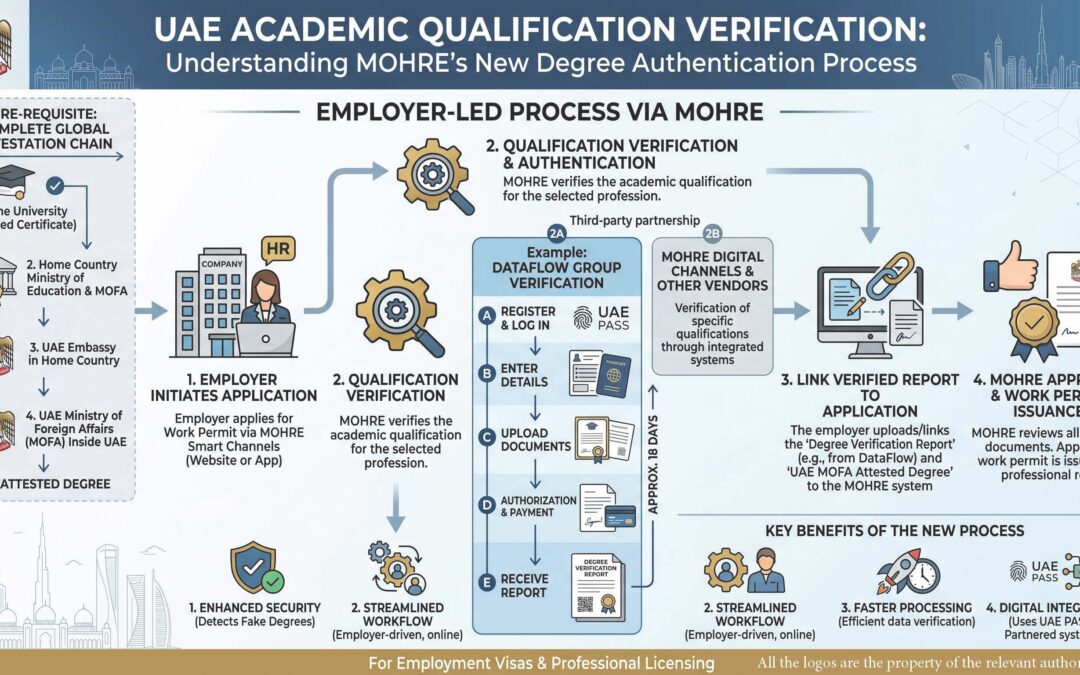
The UAE has introduced a major change in how academic qualifications are verified for private sector employees. In May 2025, the Ministry of Human Resources and Emiratisation (MOHRE), in partnership with the Ministry of Higher Education and Scientific Research (MoHESR), launched the Academic Qualification Verification Project, a digital initiative designed to verify academic credentials used for employment in the UAE private sector. MOHRE’s New Degree Authentication Process.
Many employers and employees are confusing this new process with traditional degree attestation or degree equivalency. However, these are three separate processes with different purposes.
This article explains what the new verification process is, why it was introduced, who is responsible, and how it differs from attestation and qualification recognition (formerly known as equivalency).
What is the MOHRE’s New Degree Authentication Process, Academic Qualification Verification Process?
Academic Qualification Verification is a digital verification system integrated into MOHRE’s work permit process.
The objective is to confirm directly that a degree submitted by an employee is genuine and was actually issued by the stated university or educational institution. The verification is conducted electronically through authorized verification partners and coordinated between MOHRE and MoHESR.
The initiative initially applies to:
- Private sector employees
- Skill Levels 1 to 4
- Academic degrees issued outside the UAE
The system is expected to expand later to include UAE-issued qualifications as well.
Why Was This Introduced?
The UAE government introduced the project to:
1. Prevent fraudulent qualifications
Historically, a document could be legally attested even if the issuing institution was difficult to verify. The new process adds an additional layer of authenticity verification directly with educational institutions.
2. Improve hiring quality
Employers can have greater confidence that candidates possess the qualifications they claim, improving workforce quality and professional standards.
3. Support digital transformation
The initiative aligns with the UAE’s digital transformation agenda and the Zero Government Bureaucracy Programme by reducing paperwork and creating a unified verification process.
4. Protect the labour market
The project strengthens labour market integrity and reduces risks associated with fake or unverified educational credentials.
Who is Responsible?
MOHRE
MOHRE has integrated qualification verification into the work permit process and employment ecosystem.
MoHESR
MoHESR acts as the academic verification authority responsible for validating qualifications.
Verification Providers
Authorized partners may conduct Primary Source Verification (PSV) directly with universities and educational institutions. Common providers include:
- DataFlow
- QuadraBay
- VFS Global
These organizations contact institutions and verify degree authenticity on behalf of the UAE authorities.
Employers
Employers are generally responsible for initiating the process through the work permit application system and ensuring the employee provides required documentation.
Employees
Employees must provide authentic academic documents and may be required to sign authorization forms allowing verification agencies to contact their universities.
Is the Process Random?
Many employers have observed that only certain employees are being selected.
Based on current implementation, the system appears to target specific work permit applications, particularly those involving academic qualifications for Skill Levels 1–4. In practice, some employers report that verification requests are being triggered automatically by the MOHRE system during permit processing.
As the programme expands, broader coverage should be expected.
Is Verification Required Only Once?
The government’s objective is to create a unified verification record and “one-time verification process” linked to the qualification.
In principle, once a degree has been successfully verified and recorded, repeated verification should not normally be required for the same qualification.
However, because the programme is relatively new, employers and employees should monitor future MOHRE and MoHESR announcements for confirmation of re-verification requirements.
Degree Attestation vs Degree Verification vs Degree Recognition (Equivalency)
This is where most confusion arises.
1. Degree Attestation
Attestation confirms that a document is legally authenticated through government channels.
Typical attestation process:
- University issuance
- Home country authentication
- Foreign Affairs authentication in issuing country
- UAE Embassy legalization
- UAE Ministry of Foreign Affairs (MOFA) attestation
Purpose:
- Confirms document legitimacy
- Confirms signatures and seals
- Required for many immigration and employment procedures
Attestation does NOT independently confirm whether the degree itself is academically valid or whether the university officially issued it.
2. Academic Qualification Verification (New MOHRE Process)
Verification confirms:
- The degree was genuinely issued
- The university exists
- The qualification belongs to the applicant
- The records match university databases
Purpose:
- Employment verification
- Work permit processing
- Fraud prevention
Verification often involves direct communication with the educational institution through authorized verification providers.
3. Qualification Recognition (Previously Called Equivalency) / MOHRE’s New Degree Authentication Process
Qualification Recognition, formerly known as Equivalency, is administered by MoHESR.
Its purpose is to determine whether a foreign qualification meets UAE academic standards and can be officially recognized within the UAE education system.
Recognition is commonly required for:
- Admission to higher education
- Regulated professions
- Government employment
- Academic progression
Recognition is not the same as attestation and not the same as employment verification.
Comparison Table
| Process | Purpose | Conducted By | Required For |
|---|---|---|---|
| Degree Attestation | Legal authentication of documents | Home country authorities + UAE MOFA | Immigration, employment, legal use |
| Academic Qualification Verification | Confirm degree authenticity directly with institution | MOHRE / MoHESR / Verification Partner | Work permit and employment verification |
| Qualification Recognition (Equivalency) | Determine academic recognition in UAE | MoHESR | Academic and regulated professional purposes |
Expected Timelines
Actual timelines vary significantly based on:
- Country of issuance
- University responsiveness
- Verification provider
- Complexity of records
Industry experiences reported by applicants suggest:
- Fast cases: 2–3 weeks
- Typical cases: 2–6 weeks
- Complex cases: Several months
Universities that respond quickly generally result in faster completion.
How Can Employers Confirm the Requirement?
Employers can verify information through:
- MOHRE website and smart application
- MOHRE business service centres
- Official MOHRE announcements
- MoHESR qualification services
- Authorized verification partners
Official references:
- MOHRE Academic Qualification Verification Announcement
- MoHESR Qualification Recognition Portal
- VFS Global MoHESR Services
What Should Employers Do Now?
HR departments should:
- Identify employees in Skill Levels 1–4 whose positions require academic qualifications.
- Ensure degree certificates are available and properly attested.
- Prepare employees for possible verification requests.
- Inform candidates during recruitment that academic verification may be required.
- Allow additional lead time for work permit processing when verification is triggered.
Conclusion
The UAE’s Academic Qualification Verification Project represents a significant shift from document-based validation to direct qualification verification. While degree attestation remains important and qualification recognition remains necessary for academic purposes, the new verification process focuses specifically on confirming that a degree is genuine and belongs to the individual presenting it.
For employers, the initiative improves confidence in hiring decisions. For employees, it highlights the importance of maintaining authentic and verifiable academic records. As the system expands across the labour market, academic verification is likely to become a standard component of skilled employment in the UAE.
Official References
- MOHRE Announcement on Academic Qualification Verification Project
- MoHESR Qualification Recognition Services
- VFS Global – MoHESR Qualification Recognition Services
Disclaimer: The information contained in this article is accurate to the best of our knowledge at the time of writing and is based on publicly available information and official announcements. Government regulations, procedures, fees, and requirements may change without notice. Readers are advised to verify all information directly with the relevant authorities, including MOHRE, MoHESR, and authorized service providers, before making any decisions or taking action. The author and publisher accept no responsibility for any loss, inconvenience, or consequences arising from reliance on the information provided in this article.
Read more My Blog